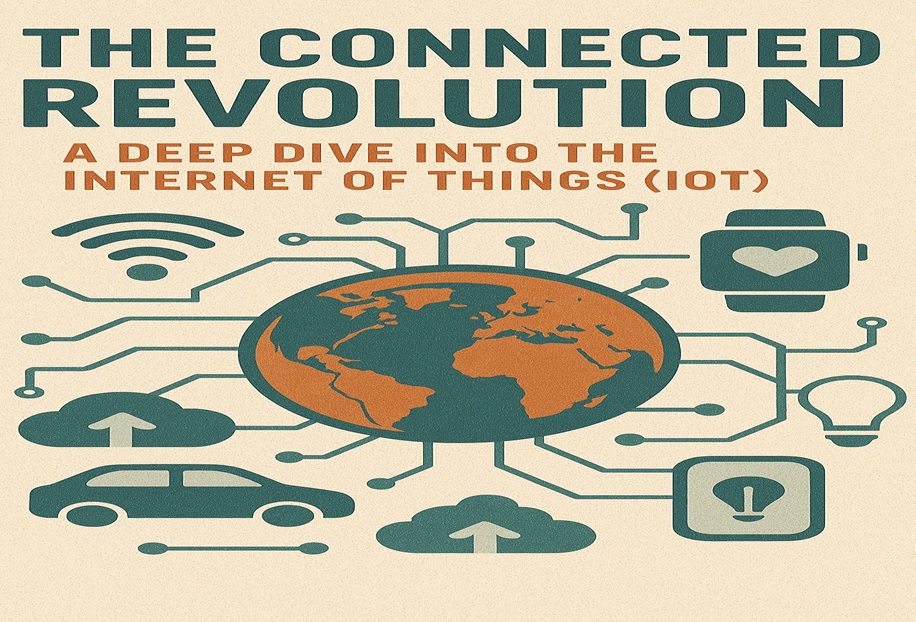
One of the 21st century’s most revolutionary technologies is the Internet of Things (IoT). By making it possible for commonplace objects to connect to the internet and speak with one another, it has completely changed the way that people, systems, and gadgets interact. IoT is changing industries and redefining the limits of connectivity, from smart homes to industrial automation.
This article offers a thorough examination of the Internet of Things, including its elements, uses, advantages, difficulties, and prospects.
The Internet of Things, or IoT, is what?
A network of physical things equipped with sensors, software, and other technologies that allow them to gather and share data with other devices via the internet is known as the “Internet of Things.” These “things” include everything from wearable technology and home appliances to urban infrastructure and industrial machines.
Important Elements of IoT
Sensors and Devices: These are the “things” that gather environmental data. Wearable technology, cameras, and temperature sensors are a few examples.
Connectivity: Wi-Fi, Bluetooth, Zigbee, and cellular networks are just a few of the technologies that IoT devices use to connect.
Data processing: After being gathered, data is either transferred to the cloud for analysis or processed locally (edge computing).
User Interface: Through dashboards or applications, users engage with IoT systems, allowing them to monitor and manage devices.
How the Internet of Things Operates
Hardware, software, and networking technologies are seamlessly integrated to power the Internet of Things. Here is a detailed rundown of how it works:
Data Collection: Sensors gather information about the surroundings or how the device is operating.
Data Transmission: A central system or cloud platform receives the gathered data.
Data analysis: To extract insights or initiate actions, sophisticated algorithms examine the data.
Action: Depending on the analysis, certain actions are performed, such notifying a user or modifying a thermostat.
IoT applications
IoT applications improve productivity, convenience, and creativity in a variety of industries.
- Intelligent Houses
The idea of home automation has been completely transformed by IoT. The ability to remotely operate smart devices, such as security cameras, lighting controls, and thermostats, improves security and comfort.
- Medical Care
Wearable technology, remote patient monitoring, and networked medical equipment are all ways that the Internet of Things is revolutionizing healthcare. Early diagnosis and real-time health tracking are made possible by these technologies.
- IoT for Industry (IIoT)
IoT helps industries with automation, supply chain optimization, and predictive maintenance. Connected sensors track the condition of machinery and production procedures, decreasing downtime and increasing productivity.
- Intelligent Cities
The foundation of smart cities is IoT technology, which makes it possible to manage waste, transportation, and energy use effectively. For instance, smart streetlights change their brightness in response to foot traffic.
- Agriculture
Smart irrigation systems, soil sensors, and animal monitoring are examples of IoT applications in agriculture. These developments aid in resource optimization and productivity growth.
- Retail
IoT is used by retailers for smart checkout systems, individualized consumer experiences, and inventory management. In this industry, RFID tags and beacons are typical IoT tools.
IoT advantages
IoT’s broad adoption has opened up a number of advantages for several industries:
Enhanced Efficiency: IoT increases productivity by automating procedures and minimizing human participation.
Cost Savings: Businesses can save money by optimizing their resources and using predictive maintenance.
Better Decision-Making: Actionable insights from real-time data facilitate well-informed decision-making.
Personalization: IoT makes it possible for retail, healthcare, and other industries to provide individualized experiences.
Improved Quality of Life: Wearable technology and smart homes enhance convenience and health care.
IoT challenges
Despite its benefits, IoT has a number of drawbacks.
- Privacy and Security
As there are billions of internet-connected devices, protecting user privacy and data security is a major challenge. Sensitive information may be compromised by cyberattacks and data breaches.
- Interoperability
IoT devices and protocols are not standardized, which leads to compatibility problems and prevents smooth integration.
- Scalability
Keeping up with an expanding network of linked devices is a difficult undertaking that calls for reliable infrastructure.
- Energy Use
For continuous operation, IoT devices—particularly those located in remote areas—need effective power solutions.
- Adherence to Regulations
Regulations to handle the moral and legal ramifications of IoT are still being developed by governments and organizations.
New Developments in IoT
A number of trends are influencing the future of IoT as it develops further:
- Computer Edges
Real-time decision-making is improved and latency is decreased when data is processed closer to the source (edge). In fields like industrial automation and driverless cars, this technique is becoming more popular.
- 5G Internet Access
By enabling more sophisticated applications and quicker, more dependable connectivity, the introduction of 5G networks will improve the Internet of Things.
- Integration of Artificial Intelligence (AI)
IoT systems with AI capabilities are able to process data more efficiently, facilitating autonomous decision-making and predictive analytics.
- IoT in Monitoring the Environment
As part of sustainability initiatives, IoT devices are being used to monitor animals, water levels, and air quality.
- IoT blockchain
IoT and blockchain technology are being used to improve data sharing and transaction security and transparency.
The Internet of Things’ Future
IoT has a promising future as technological developments open the door to even more creative uses. Personalized healthcare solutions and intelligent transportation systems are just two examples of how the Internet of Things will continue to shape our interconnected world.
Every element of our life could be completely transformed by the revolutionary technology known as the Internet of Things. IoT improves quality of life, encourages creativity, and increases efficiency by tying people, systems, and gadgets together. To realize its full potential, however, issues like security, scalability, and interoperability must be resolved. As IoT develops, it promises to make the world more intelligent and connected, advancing various industries and enhancing people’s lives everywhere.